Carl Jung
1875 to 1961
A Swiss psychiatrist who spent his life on one question: what is going on in the part of a person that the person cannot see. He gave us the shadow, the archetypes, introversion and extraversion, and the idea that becoming yourself is the work of a whole life rather than something you finish in your twenties.
What follows is the life, told as a life, with each turn in it linked to the idea it produced.
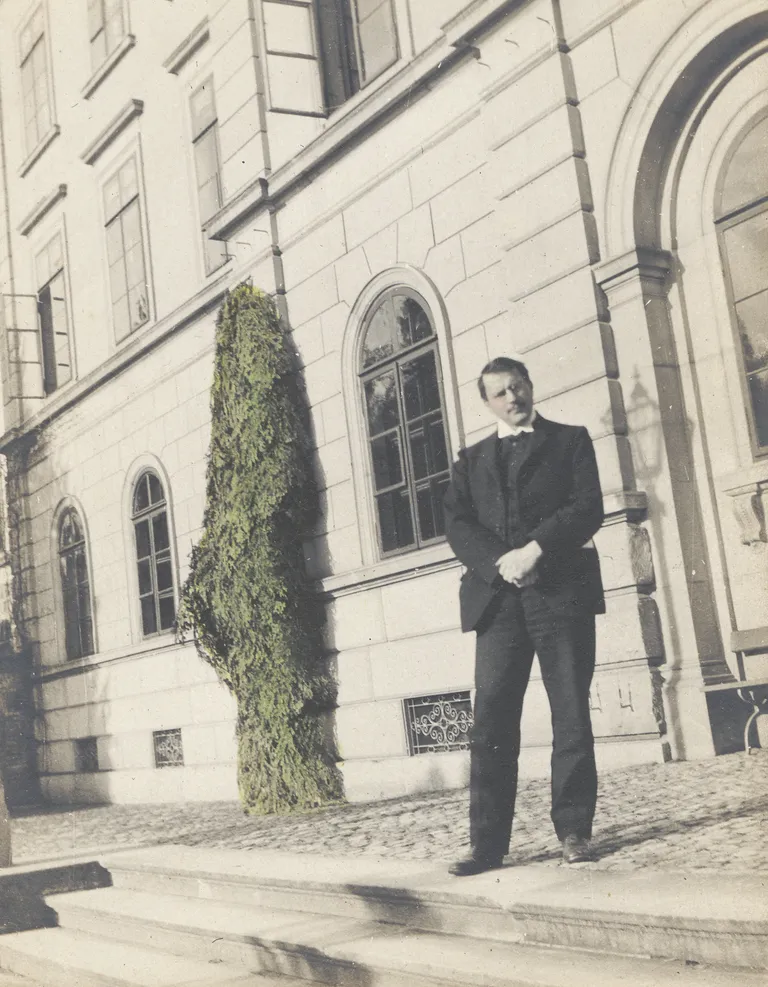

A note on sources. Many of the best-known stories about Jung come from Memories, Dreams, Reflections, which is Jung recalling his own life in his eighties, compiled with his collaborator Aniela Jaffé, who wrote much of the text from their conversations, and published after his death. Those are marked here as his account rather than presented as documented fact. Where sources disagree, this page takes the careful reading.
1875 to 1895
The parsonage
Carl Gustav Jung was born on 26 July 1875 in Kesswil, a village on Lake Constance in the Swiss canton of Thurgau. His father, Paul Jung, was a Swiss Reformed pastor; the family moved twice in his early childhood, ending up in a parsonage at Kleinhüningen near Basel. His father struggled with a faith he could no longer feel. His mother, Emilie, he remembered as warm and companionable and also as something else: he wrote that he was sure she consisted of two personalities, one innocuous and human, the other uncanny. When he was around three she spent several months in a hospital in Basel and he was left with an aunt and the family maid, an absence he wrote about, decades later, as having troubled him deeply.
He was a solitary child who invented his own company. He carved a small manikin out of the end of a wooden ruler, hid it in the attic in a pencil case with a painted stone, and brought it scrolls in a language he made up. Decades later he found the same gesture in other cultures and understood he had performed a ritual nobody had taught him.
He also recounted the earliest dream he could remember, from around the age of three or four: a stone stairway leading underground into a chamber where something enormous stood on a throne, which he recognised only much later as a ritual phallus, and which his mother's voice in the dream called the man-eater. He kept it secret for most of his life. Whatever else it was, it was the first time he found that the psyche produces images it never learned.
1895 to 1906
Medicine, and the experiment that made his name
He entered the University of Basel in 1895 to study natural sciences and medicine. His father died the following year, leaving the family short of money, and relatives helped him finish. By his own account he chose psychiatry near the end of his studies after reading a textbook preface that showed him a field where natural science and the questions he actually cared about could occupy the same room.
He finished his medical studies and passed the state examination in 1900, and in December went to the Burghölzli, the cantonal psychiatric hospital and university clinic in Zurich, then directed by Eugen Bleuler. The doctorate itself came from Zurich in 1902, for a dissertation on the psychology of so-called occult phenomena built partly from séances he had attended with a young cousin. In 1903 he married Emma Rauschenbach; they had five children, and she became a serious analyst in her own right.
The work that made his name was mundane in method and startling in result. With his colleague Franz Riklin he ran word association experiments: read a word, record the response, time it to a fraction of a second. The hesitations and stumbles clustered, and the clusters had themes. Something organised and emotionally charged was operating below the person's awareness and interfering with their speech, on a stopwatch, measurably. He did not coin the word complex, but he made it central to psychology and supplied the experimental evidence for it.
1906 to 1913
Freud: six years, and the break
Jung and Freud began corresponding in 1906, after Jung sent him the association studies. They met in Vienna on 3 March 1907, and Jung recalled that they talked for something like thirteen hours almost without pause. For a few years the relationship was extraordinarily close. Freud saw in Jung the man who would carry psychoanalysis beyond its Viennese circle, and in 1910 Jung became the first president of the International Psychoanalytical Association.
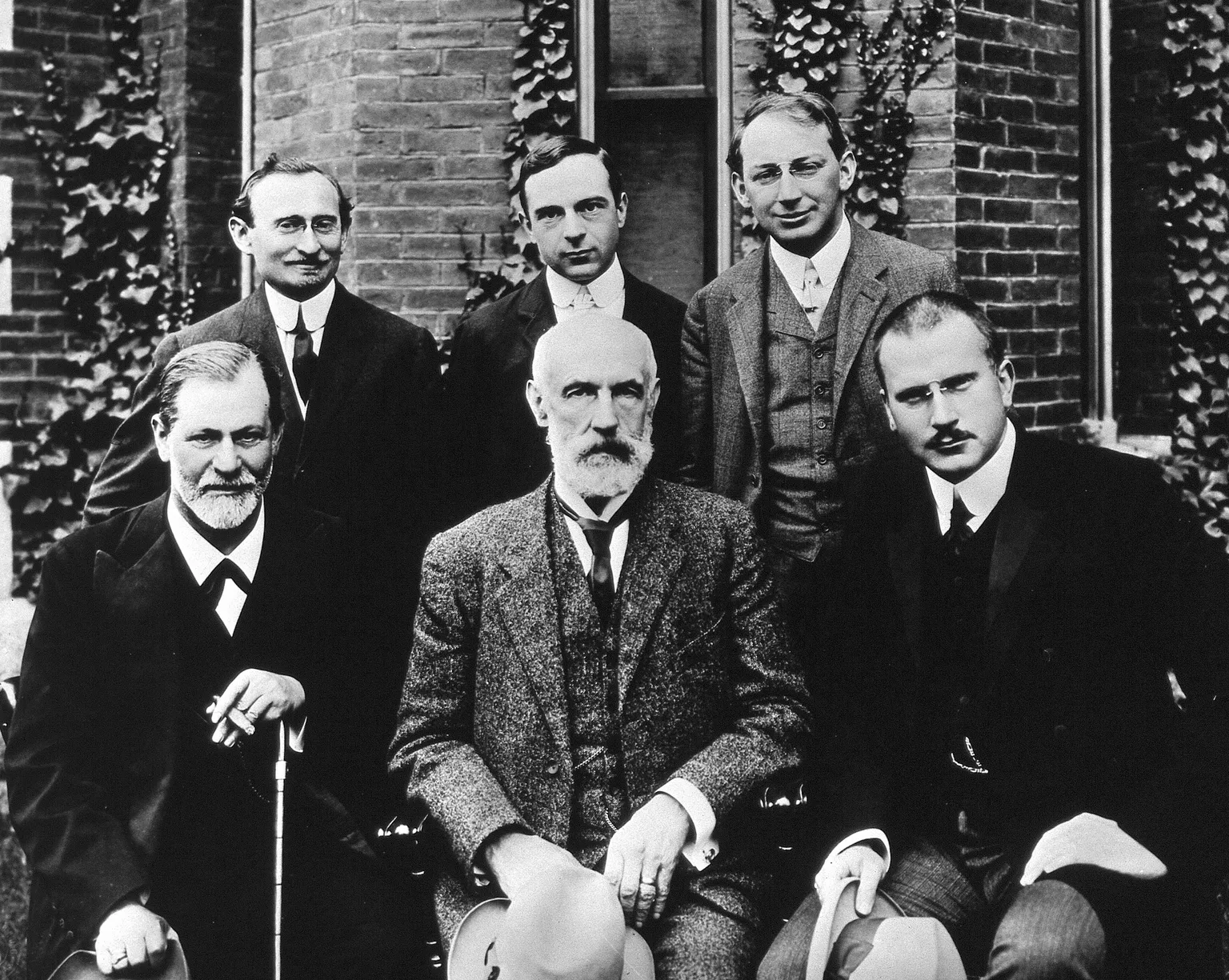

In August 1909 the two sailed for the United States together with Sándor Ferenczi, for Clark University's twentieth anniversary that September, where Freud gave the five lectures that marked the formal introduction of his theories in America, Jung lectured on the association method, and both received honorary degrees. It was the only time Freud crossed the Atlantic. Jung came back repeatedly, and what he saw on those later trips changed him.
The disagreement underneath was a genuine theoretical one, though personal strain ran alongside it throughout. Freud held that libido was fundamentally sexual; Jung came to treat it as general psychic energy, the life force that could take many forms. He also held that the unconscious was not only a basement for what a particular person had repressed, but included a layer shared by everyone. The 1911 and 1912 instalments of the book that eventually became Symbols of Transformation set that idea going, and he later said it was that book which cost him the friendship. Scholars tend to read it as crystallising a rift already forming.
In January 1913 Freud wrote proposing they end their personal relationship. They saw each other for the last time at the Munich congress that September, and Jung resigned the presidency in 1914. He was thirty-eight, he had lost his closest intellectual ally and his standing in the movement, and what came next was the strangest and most productive period of his life.
1913 to 1930
The confrontation with the unconscious
He called it his confrontation with the unconscious. Beginning in the winter of 1913 he deliberately induced waking fantasies and then entered them, as one enters a play, and wrote down what happened. He recorded it first in a series of small notebooks now called the Black Books, and later transcribed and illuminated the material into a large red leather folio. That folio is Liber Novus, the Red Book.
The practice he built to do this became active imagination, and it is still the most distinctive technique in Jungian work. One of the figures, an old man with the horns of a bull and the wings of a kingfisher, first came to him in a dream; he called him Philemon. In his memoir Jung is recorded as saying that Philemon taught him psychic objectivity, the reality of the psyche, and said things he had not consciously thought.
He also reported, in his memoir, a waking vision in October 1913 of a monstrous flood covering the lands between the North Sea and the Alps, the water turning to blood, which returned two weeks later more vividly still. The following summer Europe went to war, and he came to read the vision as a premonition.
Whether this period was a breakdown is genuinely contested. Some readers have called it a psychotic episode; Sonu Shamdasani, who edited the Red Book, argues that reading cannot be sustained on the documents, and points out that Jung kept a full analytic practice throughout. Jung himself, describing those 1913 visions, wrote that he first concluded he was menaced by a psychosis, a reading he abandoned once the war broke out. The honest version is that a man deliberately went as far down as he could and came back with a method, and that he was frightened while doing it.
He worked on the Red Book for about sixteen years and never finished it, filling roughly 205 of its six hundred pages and breaking off around 1930 in the middle of a sentence. His family kept it private for decades. It was finally published in 2009, edited by Shamdasani, and it turned out to contain the seed of nearly everything he wrote afterward.
1922 to 1955
The tower
In 1922 he bought land at Bollingen on the upper basin of Lake Zurich, and in 1923 he built a round stone tower there. He extended it in stages over the following twelve years, and once more twenty years after that, each stage answering something in himself: a central structure with an annex in 1927, an extension in 1931 giving him a retiring room he kept the key to and that nobody entered without his permission, a walled courtyard and a loggia on the lake in 1935, and an upper storey after Emma died in 1955.
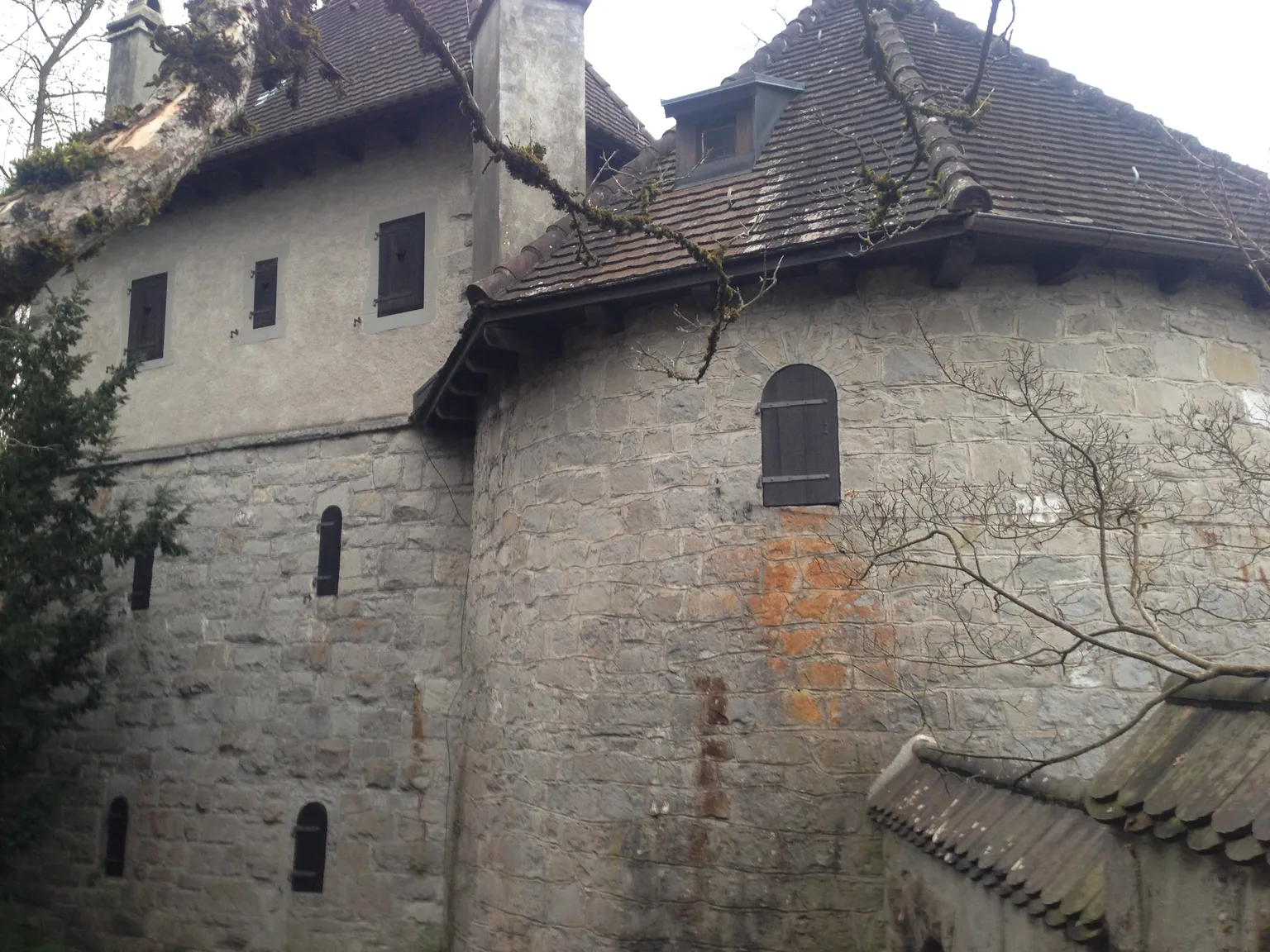

He worked on it physically, alongside the hired workmen, and cut and chiselled stone himself. The popular line that he built it with his own hands overstates it; that he laid stone with his own hands does not. He kept the place without electricity or running water, and wrote that he tended the fire, pumped the water, chopped the wood and cooked the food himself. In 1950 he carved a cube of stone that had turned up at the site by mistake, and cut into its faces an alchemical verse, a small hooded figure, and a line from Heraclitus about time as a child at play.
It is worth knowing about the tower because it is the clearest physical evidence of what he actually believed. He thought the psyche needed to be lived and not only theorised, so he built a place with his hands where he could live it. Of the storey he added after Emma died he wrote that he felt an inner obligation to become what he himself was, and could no longer hide behind the other towers.
1944
The year he nearly died
Early in 1944, at sixty-eight, he broke his foot and then had a heart attack. In his memoir he wrote that while unconscious he experienced visions of such magnitude that he concluded he was close to death: seeing the earth from perhaps a thousand miles up, Ceylon far below his feet and India ahead of him, bathed in what he called a gloriously blue light, the most glorious thing he had ever seen.
He wrote that he came back reluctantly, and that a fruitful period followed in which a good many of his principal works were written. This is his account of an inner experience, not a report of an event, and he was careful about that distinction himself. What is not in question is that everything most people mean by late Jung comes after 1944.
1946 to 1957
The late work
The last stretch is the strangest and, for many readers, the best. Aion (1951) traced the fish symbol through two thousand years of Christian imagery as one strand of a wider inquiry into the Self. Answer to Job (1952) read the Book of Job as a drama in which God is confronted by his own unconsciousness, and it provoked the controversy he later said he had expected. That same year he published his essay on synchronicity in a joint volume with the physicist Wolfgang Pauli. Mysterium Coniunctionis, finished in his eighty-first year, read the alchemical literature as a symbolic record of the union of opposites, and he wrote of it that his task was finished, his work done, and now it can stand.
Emma Jung died in November 1955, after more than fifty years of marriage and her own work as an analyst and writer, including her essays on the animus and anima and the Grail research that Marie-Louise von Franz completed after her death.
1959 to 1961
I know
In March 1959 the BBC filmed him at his house in Küsnacht for the interview series Face to Face. John Freeman asked whether he had believed in God as a child, and Jung said yes. Then Freeman asked whether he believed now. The transcript records a pause, and then:
Now? Difficult to answer. I know. I don't need to believe. I know.
It is usually quoted as “I don't believe, I know”, which drops his “need to”. He said he knew first, and then that knowing made believing unnecessary. The interview closes with another line worth keeping: man cannot stand a meaningless life.
The broadcast had one more consequence. A publisher saw it, and asked Freeman to persuade Jung to write something for ordinary readers. Jung refused. By Freeman's account he then reconsidered, moved by the flood of letters the broadcast brought from ordinary viewers and by a dream in which he stood addressing a crowd who listened and understood, and he agreed on two conditions: that he choose his own collaborators, and that Freeman coordinate the book. The result is Man and His Symbols, conceived from the start for readers who were not specialists. Jung planned it, chose the contributors, and wrote its opening chapter, finishing about ten days before his final illness. It was published in 1964.
He died at home in Küsnacht on 6 June 1961, aged eighty-five.
What he gave us
A century later, most of these have escaped the field entirely and become ordinary words. Each one links to the page here that explains it properly, in plain language first.
- The collective unconscious
The claim that underneath your personal history lies a layer of psyche that is not personal at all, and that this is why strangers on opposite sides of the world dream in the same images.
- The shadow
The parts of yourself you pushed out of sight, and his insistent point that they do not stay out of sight. They come back as the thing you cannot stand in other people.
- The persona
The face you present to the world. Necessary, and dangerous only when you forget it is a face.
- The anima and animus
The contrasexual inner figure, which much post-Jungian writing has reread as something wider. This site offers that wider reading as the Inner Other.
- The Self
The wholeness that is larger than your everyday sense of I, and the centre that the whole process is circling toward.
- Individuation
The lifelong work of becoming who you actually are rather than who you were told to be. The idea that arguably organises everything else he wrote.
- Complexes
Emotionally charged clusters of ideas that act with a will of their own. He took the word from Theodor Ziehen, but he made it central to psychology and, in the laboratory, gave it its evidence.
- Introversion and extraversion
Two words whose psychological meaning is his, now so ordinary that almost nobody knows where it came from.
- The psychological types
Thinking, feeling, sensation, intuition, each turned inward or outward. The distant ancestor of the Myers-Briggs and what descends from it, none of which he had a hand in.
- Compensation
His most distinctive contribution to dream analysis: the idea that a dream tends to balance the waking attitude rather than repeat it.
- Active imagination
The practice he began working out for himself at the end of 1913 and named only years later. You go back into the image while awake and let it answer.
- Synchronicity
Meaningful coincidence, taken seriously. His most contested idea, named as early as 1930 but worked out fully in his seventies, in conversation with the physicist Wolfgang Pauli.
In his own words
Jung is one of the most misquoted people in psychology. Every line below was checked against the published work it comes from, and a few of the famous ones did not survive that check.
My life is a story of the self-realization of the unconscious.
As far as we can discern, the sole purpose of human existence is to kindle a light in the darkness of mere being.
The widely shared short form drops both 'As far as we can discern' and 'human', which turns a hedged remark into a slogan. The full sentence is used here.
The psychological rule says that when an inner situation is not made conscious, it happens outside, as fate.
This is the genuine passage that the famous 'make the unconscious conscious and you will call it fate' line loosely paraphrases.
The meeting of two personalities is like the contact of two chemical substances: if there is any reaction, both are transformed.
The shoe that fits one person pinches another; there is no recipe for living that suits all cases.
Usually mangled twice over, as 'the shoe that fits one man' and 'no universal recipe'. Neither appears in the published text.
Who looks outside dreams; who looks inside awakes.
In place it reads differently: “Your vision will become clear only when you can look into your own heart.” Almost always quoted bare, and it reads differently in place: Jung was telling one patient to look into her own heart, not offering an aphorism. The published text has no commas.
One that is not his. “Until you make the unconscious conscious, it will direct your life and you will call it fate” appears on a great many posters and in no book Jung wrote. It is a modern paraphrase, and it drifts: his actual rule, quoted above from Aion, is that an inner conflict left unconscious gets lived out in the world and experienced as fate.
Where to start reading
Two doors, and which one you want depends on what you came for. Memories, Dreams, Reflections is the life: Jung telling his own story near the end of it, in ordinary language, which puts biographical ground under every idea he had. Man and His Symbols is the ideas: the book made deliberately for people who had never read him, which he planned and opened himself. If you want to understand the man, start with the first. If you want the concepts, start with the second. Almost nobody should start with the Collected Works.
Start here
Then, in whatever order pulls
- Modern Man in Search of a Soul1933
Eleven essays on dream analysis, psychological types, the stages of life, his differences with Freud, and the relation of psychotherapy to religion.
For decades this was the standard English entry point, and it still works as one. Shorter and more approachable than anything in the Collected Works.
- Psychological Types1921 in German, Collected Works volume 6
The book that introduced introversion and extraversion along with the four functions: thinking, feeling, sensation, and intuition.
Its indirect descendants include the Myers-Briggs instrument, which Jung had no hand in. Chapter eleven, the Definitions, is the most useful glossary of his own terms he ever wrote.
- Symbols of Transformation1912, revised 1952, Collected Works volume 5
His reading of one woman's fantasy material as a route into myth, hero legend, and the symbolism of psychic energy, and the book in which he broke publicly with Freud's theory of libido.
One book in two states, which is why it seems to have three titles. It appeared in 1912 as Wandlungen und Symbole der Libido, reached English in 1916 as Psychology of the Unconscious, and was thoroughly rewritten by Jung in 1952 as Symbole der Wandlung, which became Symbols of Transformation in English in 1956. The 1952 revision is the one in the Collected Works, and the title Symbols of Transformation does not exist before it.
- The Archetypes and the Collective Unconsciousessays from 1933 to 1955, Collected Works volume 9 part 1
The core essays on the archetypes, the mother, the child, the trickster, rebirth, the anima, together with the case for a layer of psyche shared across humanity.
The most-cited volume of the Collected Works, and the place where archetype is actually defined rather than assumed. The essays stand alone, so it reads well out of order.
- Aion1951 in German, Collected Works volume 9 part 2
A study of the Self as the organising centre of the psyche, opening with short chapters on the ego, the shadow, and the anima and animus before tracing the fish symbol through two thousand years of Christian imagery.
Those first four chapters are the clearest short statement he ever gave of ego, shadow, and the inner other, and they are worth reading on their own even if the long historical middle is not for you.
- Answer to Job1952 in German, 1954 in English
His reading of the Book of Job as a psychological drama in which God is confronted by his own unconsciousness and is changed by the encounter with a human being.
His most controversial book: short, angry, and unlike anything else he wrote. He said he had to overcome the greatest inner resistances before writing it, knowing what it would unleash.
- The Red Book: Liber Novuswritten from about 1913 to 1930, published 2009
The illuminated folio in which Jung recorded and painted his own confrontation with the unconscious, kept privately by his family for decades and finally published in facsimile with translation and notes by Sonu Shamdasani.
Not theory, and not a place to begin, but the private experiment from which nearly all the later theory grew. A text-only Reader's Edition followed in 2012 for anyone who wants the words without the folio's weight.
- Mysterium Coniunctionis1955 and 1956 in German, Collected Works volume 14
His last major work: the alchemical literature read as a symbolic record of the union of opposites, and of the process he called individuation.
Completed in his eighty-first year and generally treated as the summit and the endpoint of the Collected Works. Dense and allusive, and best attempted last.
Links go to the publisher. Nothing here is an affiliate link, and the site earns nothing if you buy a book. Your library almost certainly has the first two.
He was also a man of his era, and some of its failings were his: a gendered framework, a habit of treating non-European traditions as primitive, and conduct during the Nazi years that was morally compromised. The About section says more about that, plainly, and about why this site still builds on his work.